Showing posts with label Brother Nouvelle 1500s. Show all posts

Saturday, August 10, 2024

Darn It

For a while now, one of my tea towels has had an issue.

Specifically, it's had a small hole in the relatively coarse waffle woven fabric.

Now this is certainly not the first time I've had to deal with fixing holes in fabric. For example, the handle on one of my shopping bags got caught in the trunk lid catch of a rental car once.

I used a back-and-forth technique on this repair, using my Brother CS6000i, and it went rather slowly due to it being a computerized machine (computerized machines tend to be very slow when sewing backwards).

More recently, as in earlier this week, I went through and darned all the holes in my wash cloths using my Brother Nouvelle 1500

The wash cloths in particular turned out very good, with the repairs only barely visible.

Since the Nouvelle 1500 is a mechanical machine, it can sew in full speed going forwards or backwards, and can transition between the two basically instantly.

That meant I could just put my foot to the floor and toggle the reverse lever with my right hand while my left hand guided the fabric such that it would slowly walk from right to left as the sewing machine fed it back and forth.

For the tea towel, however, I decided that I wanted to try out free-motion darning, and so it was back to the CS6000i, since that's the only machine I have a free motion foot for.

On a smaller machine like this it also helps to have an extension table, so that you have a bit more room to plant both hands on the fabric while you're moving it back and forth.

And don't forget to drop the feed dogs.

But before we get to the darning, we need some matching thread, and in terms of sewing thread I don't seem to have any good greens for this particular shade of faded tea towel.

The leafy green would have been a bit too bright and the mossy green would have been a bit too brown. The neon green would have been obviously a bit much.

Of course, I do also have machine embroidery thread.

The colour match is almost spot on, which is great. The only downside is that embroidery thread tends to be a lot glossier than sewing thread, but I think I'll be able to get away with it.

So we'll wind up a bobbin (which feels a bit weird to do with embroidery thread) and then get to sewing.

Curiously, free motion darning is one of those techniques where it's actually a lot easier to go fast than it is to go slow. The fabric only moves when the hopping foot is up (the needle bar screw lifts up against a bar on the foot at the top of the needle stroke), and so having that motion happen more frequently makes the motion much smoother.

So the trick is to drop the hammer and just go for it.

The hole closed up nicely here, but I've only done the darning in one direction (vertically in the photo). I turned the work 90 degrees and did another pass to ensure that nothing would be coming apart again.

The waffle weave did obviously flatten out a lot in the darned section, but it shows up a lot less in person than it does on camera.

And with the hole patched up, there's nothing left to do but put it back in service.

Not that I would ever hang towels from the oven door handle. No, not me, no sir.

Wednesday, July 24, 2024

An Obvious Cover-Up

This here is my Brother Nouvelle 1500S. It has an obvious problem.

It's naked.

This will be a bit of a lengthy post, so more after the break.

Monday, February 26, 2024

These Feet Were Made For Walking

Most standard lockstitch sewing machines are capable of using a specialized presser foot most commonly known as a "walking foot", although this is a little bit of a misnomer. It's a little more accurately described as an "even feed" foot, and I'll explain why that is in a moment.

My new-to-me Brother Nouvelle 1500s can take one of these feet, which is convenient as it's a quilting-focused machine and an even feed foot is very useful when trying to feed a quilt sandwich (composed of the quilt top, the batting, and the backing fabric) evenly through the machine, without getting puckers and curls caused by the different layers shifting or stretching relative to each other.

However, the original even feed foot was not included with the machine, so I took a gamble and tried buying a high-shank even feed foot off of Amazon.

This did not quite go as planned. Above we can see the Brother's regular high-shank presser foot on the right, a standard snap-on zig-zag foot to the left, and the high shank even feed foot in the middle.

What's wrong with this picture? Well, this particular even feed foot is designed for a high shank zig-zag sewing machine, which my Brother definitely is not.

Now technically I can install this foot, and I can sew through it without the needle striking the foot. However, all is not as it should be.

You see, the way this even feed foot is designed, the middle portion lifts up when the needle is at the top of its motion, and the two outer runners slide back and forth with the fabric to achieve the even feeding motion that the foot is named for.

However, this doesn't work at all if the outer runners don't actually line up with the feed dogs.

It's a little easier to see if I compare how the even feed foot from my low shank zig-zag machine lines up with the feed dogs on my straight stitch machine.

On this foot, the metal portion holds down the fabric when the needle is making a stitch, and then the white plastic pieces are pushed down against the feed dogs when the fabric is being moved through the machine. If they don't line up with the feed dogs, the fabric doesn't move.

Luckily, I was able to find the correct even feed foot for this machine.

This one is designed specifically for high shank straight stitch machines, not zig zag machines, which means the foot is much narrower in comparison with the zig zag even feed foot, and the mechanism lines up with the feed dogs properly.

We can see here how the black plastic runners line up perfectly with the feed dogs.

And so the fabric layers will be correctly pinched when the feed dogs are advancing.

And this is the secret to the even feed foot: the runners in the foot slide back and forth in unison. The fabric that's already been sewn, behind the needle, will always move as one thanks to being stitched together, but with a regular fixed presser foot the fabric in front of the needle can be dragged forwards by the friction against the underside of the foot. With the even feed foot, the runners get pulled backwards in the rear by the stitched fabric, and this then is translated into the runners pulling the fabric in front through the machine at the same rate, preventing the stretching, pulling and puckering issues.

A walking foot is notably different here. On a proper walking foot machine, the foot's feeding motion is directly actuated by the sewing machine, rather than simply passively sliding back and forth as the fabric is moved by the feed dogs in the needle plate. Walking feet also generally have a much higher stepping action, which makes them able to walk up over much bulkier seams, like those you might run into when sewing leather and thick vinyl.

But anyways, after only a little bit of a struggle with ordering the wrong part (thank goodness for Amazon returns), I have the correct even feed foot for my straight stitch machine.

Oh, Brother

This here is a Brother Nouvelle 1500s.

As with almost every sewing machine I own at this point, I picked this one up for a song because it was broken. Unlike some of the "broken" machines I've picked up, this one was actually, genuinely broken, as can be seen by what remains of the needle thread tension unit.

Removing the broken tension stud, we can also see that some parts of the tension unit are missing.

So I'm going to need to order up some replacement parts. We'll come back to this later.

The tension unit was the only part that was disclosed as broken, however when I turned the handwheel I felt that there was some binding in the machine, which isn't a great sign. Luckily it was fairly easy to locate: the binding happened once per revolution, which indicated it was somewhere along the upper shaft or feed dog mechanism (the lower shaft that drives the hook runs at twice the speed of the upper shaft that drives the needle and takeup lever). The binding also didn't change when I changed the stitch length or engaged the reverse lever, so I ruled that out too.

To narrow things down further, I powered on the machine and ran it at full speed for a good 10-15 seconds. Running the machine when it's binding will cause whatever is binding to heat up, and so it was quite easy to locate the culprit, which was one of the linkages in the takeup lever assembly.

The middle pivot here was tight, but thankfully it was easy to loosen up: just backing off the black screw allowed it to basically recenter itself, and I tightened it back up and all was mostly well.

I say mostly well, because there was still excessive end play in the upper shaft. The handwheel could move in and out by a good quarter inch or so, which is not at all normal. Luckily this was also an easy fix. Just to the right of the black bearing bushing holder above, just out of frame, is a stop collar. Loosening two screws and sliding it to the left took up all the end play and still allowed the shaft to rotate freely without binding.

Next up, the thread tree. I'm starting to think someone dropped this machine down the stairs at some point.

This part being damaged is especially annoying as a replacement costs around $40, which is a lot more than most parts. I didn't have much hope of fixing it, but I decided to see if I could massage the kinks out of it somehow, using my soft blow hammer and a solid 123 block as an anvil.

Hmm, that looks unexpectedly encouraging.

And would you look at that, hot damn.

Not gonna lie, this took quite a bit of gentle persuasion to coax it back into shape without crushing it, but somehow I managed to pull it off.

Thread tree goes up.

Thread tree goes down.

Tumbling-down-the-stairs damage aside, the machine had also seen some miles, as evidenced by the fluff gathered around the hook area.

And then there was a few spots of rust on the needle plate, suggesting it had sat in the back of someone's closet, garage or attic for a time.

Which a little autosol easily took care of.

And naturally for a machine this old, some of the glossy plastics were looking a little... Hang on a second.

Oh...

Oh yes.

Mmmmm, that's the good stuff right there.

So at this point we've got a machine that looks pretty good.

But it doesn't sew, thanks to the lack of a functioning tension unit.

Thankfully my parts order came in, so we can tend to the very important task...

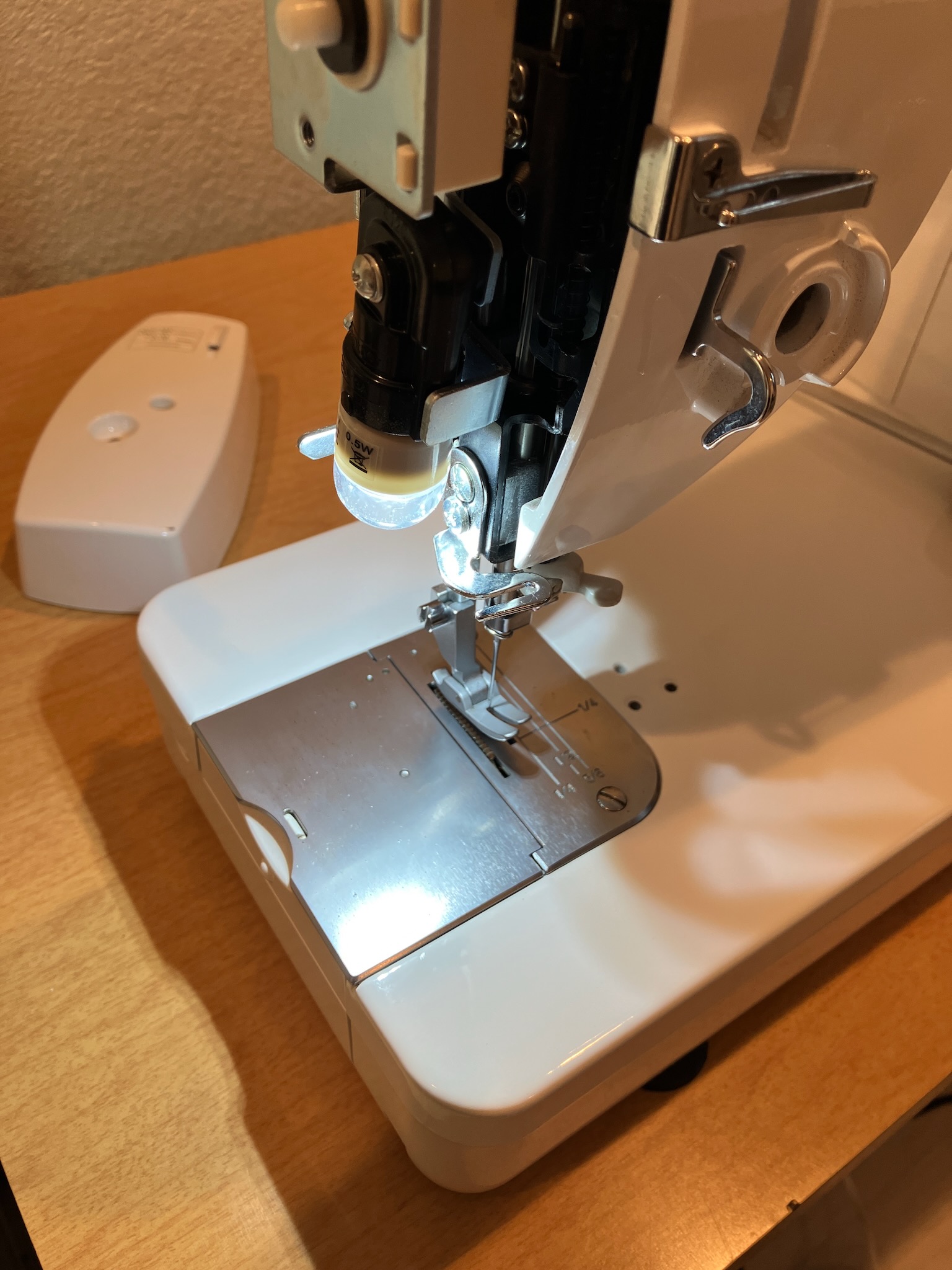
Of replacing the burnt out sewing light with a brand new LED replacement.

Ah, it's so much better already. And the light is pretty well distributed with the cover back on, which contains some reflective panels inside.

I mean it's a little shadowy over on the right side of the needle but generally you don't need to pay attention to what's on that side very often, so it's not a big deal.

Anyway, jokes aside, we need to get to the important part...

Trying out the new knee lift lever! For those of you not familiar with how these work, you push them to one side with your knee to lift up the presser foot.

And then you can lower it back down hands-free.

Which means you can actually hold onto your project with both hands while doing so.

Ok but for real this time, let's deal with this mess.

As I said, the replacement parts came in, the most important of which is the new tension unit stud.

It looks quite noticeably different from the old one.

But the stud doesn't help us if we don't have the rest of the parts.

So let's get those assembled and installed.

The parts diagram for this machine shows pretty clearly in what order all the bits are assembled onto the stud, but it doesn't show this little 2mm allen head grub screw which secures the stud into the machine. You'll want to only put this in barely finger tight at first, because we need to adjust the tension and stroke of the checkspring.

Normally the check spring sits in this position here when the thread is slack, and it helps to keep the thread from getting loose and tangled as the machine operates by accommodating the thread being pulled through the machine during the sewing cycle. When the thread is pulled taught, it rotates down into this position.

There's two adjustments for the checkspring. One adjustment is to set the stroke of the checkspring, which is done by rotating the rear tension disc after loosening this screw here, which sets the position of the stop up at the top of the tension disc.

You want to set this so that the checkspring doesn't move during the sewing cycle until the takeup lever just starts raising. This will keep the checkspring from interfering with the thread being pulled around the bobbin by the hook, while also not leaving so much slack that the needle thread gets tangled around the takeup lever.

The other adjustment is to set the preload of the checkspring, which is done by shoving a flat blade screwdriver into the end of the tension stud and rotating it. This is why we left the grub screw loose a few steps earlier, so that we could set the checkspring tension such that the spring will go to full travel before pulling the thread through the tension discs, but not be so loose that it doesn't keep the slack pulled out of the needle thread during the full sewing cycle.

Once that adjustment is set, you can tighten down the grub screw to lock it in place, and then tweak the position of the tension assembly sleeve so that the slot is pointing upwards like it's meant to do.

And now we finally have a fully functional sewing machine.