Wednesday, March 19, 2025

A Regular Allowance

You might remember my Juki LS321. If you don't, this is what it looks like.
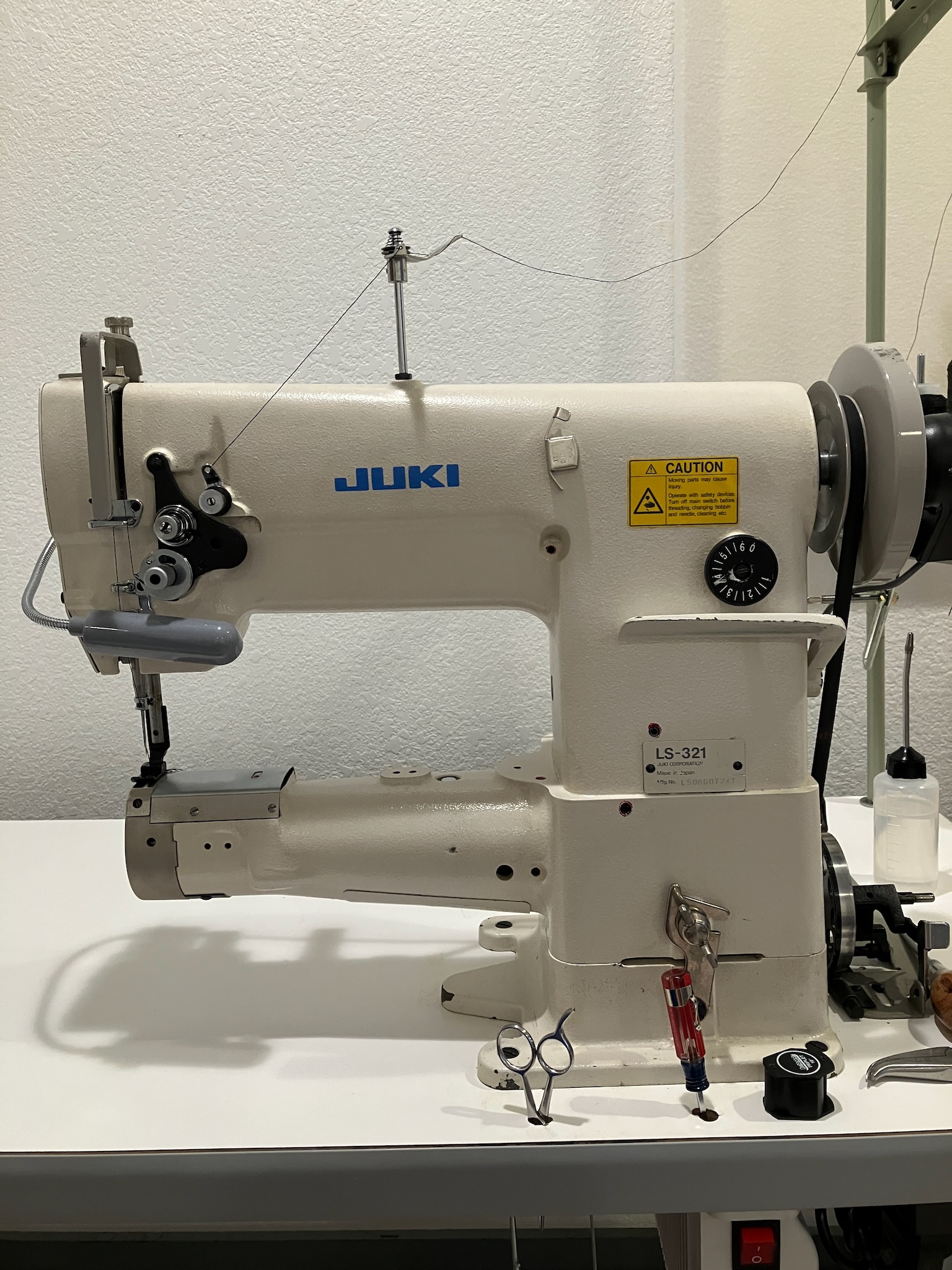
I've actually been putting it to use lately sewing up small booklets, since it has a very large maximum stitch length and I keep it threaded with some nice chunky Tex70 thread. But that's neither here nor there.

When I'm not sewing through a stack of paper, one of the things that's perhaps a little less than ideal about this machine is that there's no real markings next to the presser foot for you to judge your seam allowance by, nor is there an especially convenient way to attach a seam guide to the bed of the machine.

There's really nothing here but a smooth, featureless cover for the bobbin/hook area.

Thankfully there is a solution for this: a drop-down seam guide.

This bolts to the back of the head of the machine, and the little bearing (which can be swapped for a fixed guide, also included) guides the fabric.

But that does presume that you can mount it to the machine in the first place.

You see, it comes with M6x0.8 screws, which probably fit some more recent models of sewing machines, but definitely don't fit mine. What thread does fit mine? Well, that's where things start to get a little confusing.

Pictured below are three candidates: 1/4-28, 15/64-28 and the aforementioned M6x0.8.

The 15/64-28 is an oddball size of screw that was used by Singer (who, to be fair, designed most of their hardware well before thread sizes were standardized), and is present in a number of locations around the machine. However, it doesn't fit the holes in the back of the head where the seam guide mounts.

1/4-20 (not pictured here) is a very common size outside of sewing machines, but it had no hope of fitting: the thread was very obviously too coarse, and it seemed like the major diameter was probably too large.

M6x1.0 (also not pictured here) is also a very common size outside of sewing machines, but it too didn't seem to fit. Much like the 15/64-28, it would start to thread in but then jam up before getting anywhere.

The 1/4-28 was certainly not going to fit given that the 15/64-28 didn't fit, but it seemed like it might be a reasonable compromise: It felt like the holes were almost surely drilled and tapped for 15/64-28, but had gotten gummed up over the years, and so I either had the option to buy a 15/64-28 tap (which is surprisingly easy to find) to clean out the holes and then find some 15/64-28 screws (which are surprisingly difficult to find) to attach the seam guide, or I could buy a set of 1/4-28 taps and some 1/4-28 hardware and use that to open up the holes by 1/64th of an inch.

Well, you can see what option I went with... Except, something wasn't quite right. A 15/64-28 thread should only be 15 thousandths of an inch smaller than 1/4-28, and in fact a 15/64-28 screw will thread into a 1/4-28 hole with only a little bit of sloppiness in the fit, but trying to line the tap up and get it started in the holes wasn't working out the way I was expecting.

And that's when it occurred to me: I should probably try running a M6x1.0 tap into the holes to see how it feels.

Well here's the M6x1.0 tap after running it in. Just picked up some gunk and maybe a tiny skim of cast iron, but at no point did it feel like it was digging into the existing threads.

So these actually were M6x1.0 holes, but they were just a bit too crapped up with old dirt and dried-up oil so they felt like they were binding when I tried to thread a bolt in.

Well, I guess I bought that 1/4-28 tap set for nothing, but on the bright side I'll have it in my toolbox for some future use. It's almost always better to have a tool and not need it than to need a tool and not have it.

Anyway, the next step was to deal with the bolts. I had a stash of M6x1.0 bolts already, but they were a bit too long, even after running the tap all the way until it bottomed out. Thankfully a little work with a hack saw, a file, and a die got them shortened up appropriately.

The flange-head made things a little bit crowded when I tried to install the bolts next to each other, but luckily I had more bolt holes to choose from.

4 in total, in fact, and the mounting bracket was just wide enough to span two non-adjacent holes.

So this is what the seam guide looks like in action.

And whenever I need it out of the way, it just flips up and leaves plenty of space.

Now if you're thinking to yourself "this is all well and good, but what about the Singer 251?" then slow down there, we're getting to that next.

The 251, being a regular high-shank industrial machine, can take a much more ordinary style of seam gauge. This one bolts into place on the presser foot bar, just using the regular screw that holds the presser foot in place.

And much like the other seam guide, it flips up out of the way when the situation calls for it.

Which is very handy. I already had a bed-mounted seam guide for this machine, as well as some magnetic seam guides, but in terms of convenience this design really works well.

Neither of these were necessarily critical upgrades, but they're both very nice to have.

Sunday, March 16, 2025

Not Easy Being Green

We're pretty safely out of the frost season now, so it's time to take care of this patch of empty mulch in front of my house.

This is where I removed the honsetail previously, and I wanted to give it a while to ensure that it wouldn't be popping back up. As can clearly be seen, it has not returned.

On the other side of the plumbing and hose reel is the rosemary that came with the house, and I wanted to get something that would be somewhat similar, but not just more rosemary.

And I definitely don't need more calla lily.

I was initially thinking I should get some lemon thyme, since it has a decent mounding habit and is relatively tasty, but the nursery wasn't stocking any. After a little humming and hawing, I picked up three of these.

I have some other varieties of sage in the yard already, but this particular cultivar is bred specifically for eating.

So let's go ahead and yeet these into the ground.

Well that was easy. Can't forget the irrigation, though.

And speaking of irrigation, the weather sensor for the irrigation controller that keeps my emotional support lawn watered got knocked off its mount recently.

This can't really measure the insolation and precipitation when it's dangling on the side of my house like this.

It's really supposed to be up here, though with the queen palm growing the way it is, it's probably a good idea to move it.

I think here should do.

I could have stapled the wire up a bit more securely, but whatever.

Speaking of things that are growing, the plum is in full bloom.

As are the daisies.

And the geraniums.

The rest of the garden is still waking up, so there's not much else to show right now. I'm sure that'll change in a few weeks.

Tuesday, March 11, 2025

A Little Off The Top

The Canna plants in the back got a little frostbitten over the winter, leading to some ugly brown leaves.

So since it was a nice afternoon, I took the opportunity to prune back the damaged plants.

Luckily the ones that weren't frost damaged look fantastic.

Though admittedly it is looking a bit thin here.

It's fine though, they'll grow back pretty quickly.

Monday, March 10, 2025

Darn It All, Again

These grey socks are going to be the death of me. This time I found a pair of holes right under the ball of my foot.

So, time to get the needle and thread out again and darn it up.

Though I feel like the socks are getting pretty thin, so they might not be long for this world despite these efforts. Ah well.

Sunday, March 2, 2025

A Raven

As I've been building up my synth setup, I've quickly found myself running out of room on my already crowded coffee table, so it was really time for me to find a different piece of furniture for it to go on.

Like this piece of furniture, for example.

This is a classic writing desk, veneer over solid wood with full dovetail drawers, plus those little pull-out writing slabs on either side. It's been refinished at least once, but at least it's never been painted, which is nice.

Interestingly the dovetails are machine routed, and they actually went to the trouble to stick a piece of veneer over the back of the drawer to hide the evidence.

Which is a little bit silly, if you ask me.

Speaking of the drawers, there's some expected wear on this drawer slide.

With matching wear on the drawer.

This is easy enough to fix, though for now I'm just going to ignore it since I likely won't be using the drawers all that much. At some point I'll probably pull this whole thing apart and restore it properly, but for now I'll just enjoy it how it came.

And it even came with two receipts from 2012, a screwdriver and one (1) furniture glide.

Sweet haul!

And speaking of receipts, let's see how much this beast cost me.

Wow, almost $18. I guess I'll be eating beans and rice for the rest of the month, and I'm gonna need the calories after hauling this chonker inside.

But at least I have a sweet synth setup now.

I guess one of these days I should make some music.

Friday, February 28, 2025

Make Some Noise

So it's all well and good to have a synthesizer keyboard. The one I have is, in particular, a very tactile and immediate model, with all the controls directly at my fingertips to both shape the sound and play it melodically.

However, it is but one instrument, particularly since it's monotimbral (which is to say, it can only play (multiple) notes of one particular sound at any one time; you can't pick out two different sounds and play them both together). Most pieces of music these days are arranged for more than one instrument, so that leaves us in a bit of a quandary.

Thankfully, technology has an answer: sequencer synthesizers. In this case, in the form of a compact "groovebox".

This is the Roland Aira S-1, which is a monotimbral synthesizer with 4 note polyphony and a 64-step single-track sequencer. It has a relatively basic analog-modelled subtractive synth engine that has a square, sawtooth, sub-octave and noise oscillator which can be mixed together and filtered in various ways, plus a number of other features that I won't bother listing here.

What's important is that it's a melodic synthesizer, and it has a built-in sequencer so that I can program in a tune with a melody and/or chords, and it'll play it back in a loop hands-free so that I can play my keyboard while it does its thing.

So now I have two synthesizers, one of which plays itself, that I can set up to make two different melodic sounds. But melody is nothing without rhythm so let's go ahead and fix that.

This is the Roland Aira T-8, which is a drum and bass synthesizer. It can separately sequence 6 different drum sounds with some limited sound design options, along with a monophonic synthesized bass in either sawtooth or square wave form.

There's another part to this that I will discuss in a later post, but for now I've got a pretty decent setup going between these two grooveboxes.

And as a bonus, they're designed to daisy chain together quite nicely with 3.5mm TRS jacks, so they'll sync up the sequences between themselves via MIDI and also mix together the audio when you plug one into the other. Very convenient.

Saturday, February 15, 2025

Noisy Fidget Toys

A little while ago, as you might remember, I picked up a MIDI keyboard so that I could goof around with making music. At least, music in key-form. This worked out pretty well, but I found that there was some friction with plugging the keyboard into my computer, booting up some synth software, setting up the instruments, etc...

So the other day while I was drifting through eBay, I happened upon a listing for a Yamaha Reface CS for a suspiciously low price. Of course the unit was marked as "Parts or Repair Only" which is music to my ears, and scanning the description showed that the speakers were apparently blown but the rest of the keyboard worked as expected.

Well, not having working speakers wouldn't really do well for me, as having to hook up the keyboard to an external amp wouldn't be much different than having to hook up my MIDI keyboard to my computer. But then, just as I was closing the tab, my finger slipped and...

Oh fiddlesticks, I guess I'll just have to fix it.

Now on the bright side, a new set of speakers for one of these Reface models is only about $35 and still in production, but before I fired up an order I figured I should at least do some due diligence to see if I could reproduce the problem.

Now you might have noticed something in the photo: there's a little 1/4 to 3.5 adapter plugged into the keyboard. I'll admit I thought the same thing you probably did: they probably forgot that this adapter was in the headphone jack, and having the adapter there would mute the speakers.

But alas no, it was in the line out port.

And removing it had no effect. Oh well, free 1/4" adapter I guess.

Well, let's put that adapter to use at least and see if the keyboard is functioning with it.

And indeed it is, so that's good.

So a new set of speakers it is... except there's something not quite right, still. This keyboard has stereo speakers, and neither of them is making any sound at all. Not a very quiet whimper; not some scratchy, distorted noise; not a single peep. That's peculiar. Very peculiar indeed.

 Hmm, I wonder...

You know, just to be on the safe side, since who knows what configuration parameters the previous owner might have changed (inadvertently or otherwise), let's do a quick factory reset.

And wouldn't you know it, the speakers work just fine once you actually turn them on. There's nothing wrong with this keyboard at all.

Well, nothing critically wrong, that is.

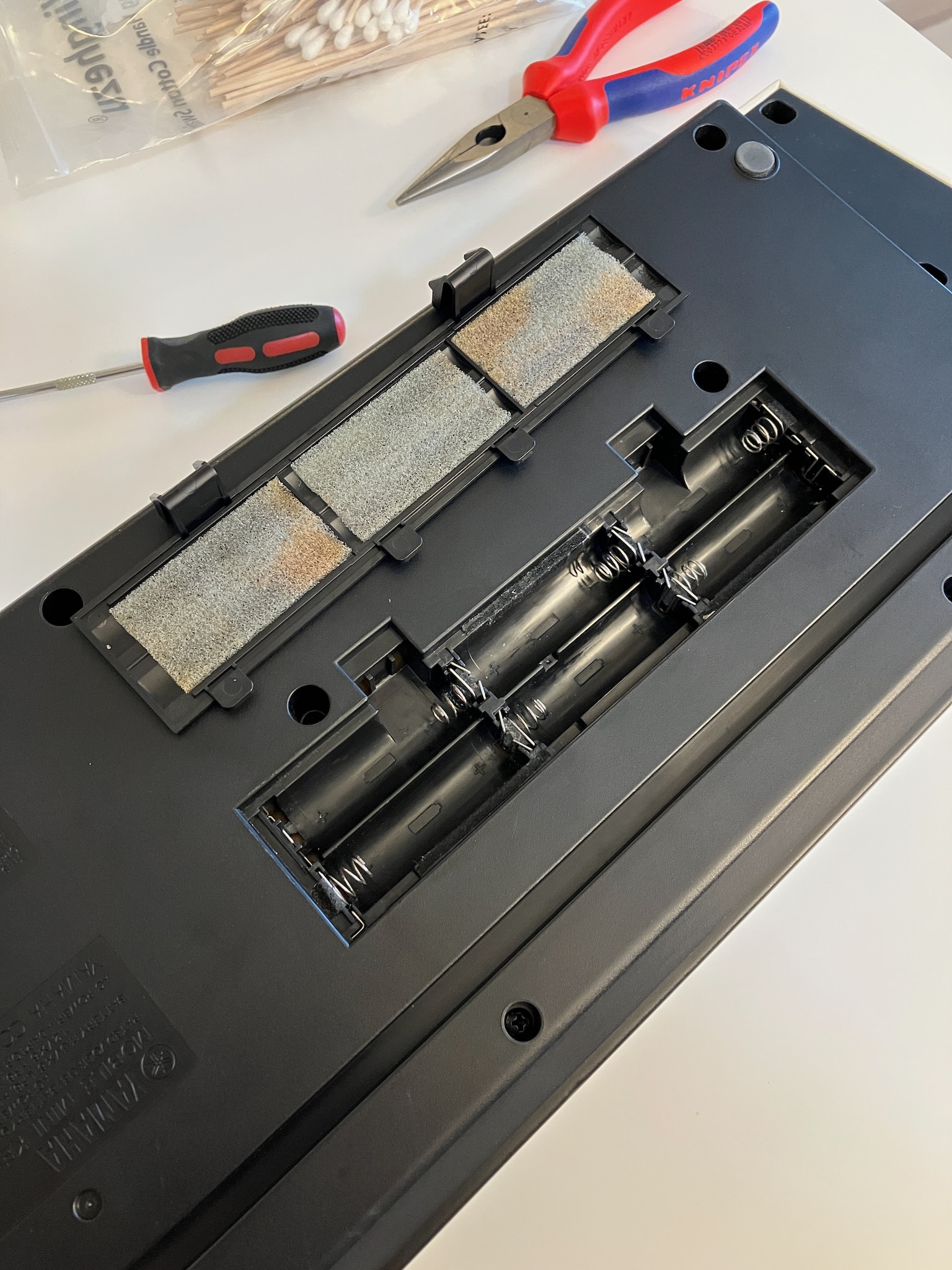
As is the case with anything that has a battery compartment, at some point someone will inevitably leave some batteries in it. This keyboard is no exception, and the previous owner had somehow even left 5 (not 6???) alkalines in the unit. There were also signs of leakage, though curiously not from this set of batteries.

In particular, this pair of terminals was a little crunchy, though luckily they weren't too damaged.

And the foam on the lid had soaked up quite a bit of electrolyte.

So it's plain white vinegar to the rescue to neutralize the caustic goo.

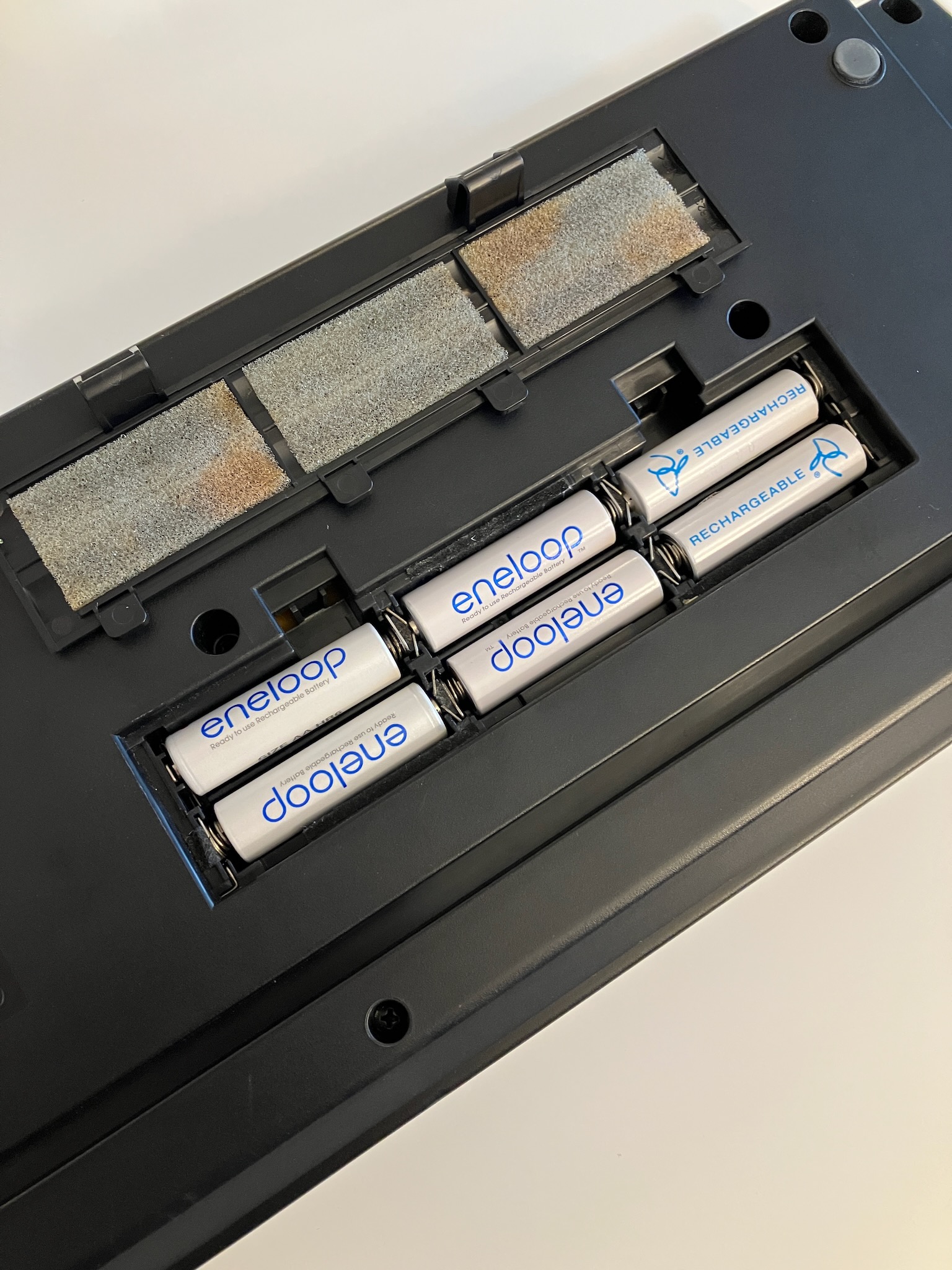
And while there's still a bit of rust staining left on the foam pads, things are basically clean again.

So, let's pop some batteries in there. Some nice NiMH cells that won't leak and destroy everything.

But that's peculiar, when I switch the unit on it acts like the batteries are almost completely dead, even though I just charged these.

Though, this one cell does look a bit lower than the others.

Ignore the negative voltage, the leads are reversed.

And with the unit powered on...

Ah,  yes, it definitely shouldn't be reading -1 volts across this cell. For comparison, we'll pop one of the alkalines in its place.

And with the power on, and the leads the right way around this time...

Ok, that's much better, and the keyboard is functioning perfectly on battery power now too. I guess I'll order up some new NiMH cells, these ones are probably 15 years old at this point.

Well, just one final step left to go: update the firmware. That means plugging it in via USB.

Damn, it's a good thing I don't throw out old cables.

And install the update.

Then with just a little bit of cleaning to wipe off the leftover finger-schmoo from the previous owner...

It's looking as good as new.

And the only thing left to do is to make some noise with my extra-loud fidget toy.