When I originally got my "broken" Yamaha Reface CS, and subsequently fixed it by turning on the speakers in the settings with a quick factory reset, one of the things I didn't take care of right away was a small but important item that was missing from the device.
That item was one of the 4 rubber feet on the bottom.
And though some may claim that a 3-legged stool will never wobble, I can safely say that the same doesn't hold true for synthesizers.
Thankfully the solution to this problem isn't too hard to come by.
And it also isn't hard to install.
So that just leaves one last detail to take care of.
Which is the above proprietary midi port connector, which Yamaha for some reason decided to use in order to cram both the midi transmit and receive into one jack, thus requiring the use of an easily lost dongle if you want to actually connect this synthesizer to other midi devices.
Getting the replacement for the one that never came with my machine wasn't hard to do, but it took a while for it to come in. Thankfully it's here now, and I'll just have to hope I never misplace it.
Since we last left off, I discovered that the side of my room that I set up my music desk on gets kind of dark in the evening. Sadly, when this addition was built on the house, they didn't actually bother putting in any overhead lights and instead tried to make do with just a tiny bit of track lighting installed where a porch light once was.
But, it just so happened that I had a spare desk lamp kicking around, so I repurposed it here.
And speaking of additions to the desk, I'd been keeping an eye out for a good deal on a Roland Aira J-6. It's from the same line as the T-8 and S-1 pictured here, but while the T-8 is focused on drum and bass sequencing and the S-1 is focused on synth lead sequencing, the J-6 is instead built around sequencing chord accompaniments and arpeggiations.
Now I don't want to get too deep into music theory here, but my expectations for how the chord banks would be laid out, and how they are actually arranged, apparently did not align particularly well.
I don't feel like my expectations were too extravagant. I just assumed that within a given set of 12 chords I'd find that they were cohesively selected to align with a particular scale key and mode, with perhaps some creative selections where they borrow the occasional chord from related keys and modes.
And I certainly at least expected that they would be roughly arranged so that they generally rose in pitch as you ascended the keyboard.
Buuuuuuuut nope. From what I can tell there's really no theme at all to each bank of chords, and whether any pair of them makes sense tonally when played next to each other seems to be pretty much down to just luck. In fact, Roland seems to have put so little effort into the selection that they even accidentally duplicated at least one bank of chords. (For those curious, Bank 5, which they classified as "Jazz", contains a chromatic set of Major-9 chords, despite one being mislabeled as a Major-7 chord, and this is identical to Bank 21, which they classified as "Utility", which also contains the exact same chromatic set of Major-9 chords, note-for-note.)
So as a result you can either poke around the chord sets randomly (and the box gives you no visual indication of what chord it's actually playing when you hit each key) in hopes of lucking upon some combination that sounds good, or use the manual to try to reverse-engineer your way through the mess of chord banks.
However, the good news is that you can also just largely ignore the preset chord bank and just input your own chords into the sequencer by picking the notes on the built in 13-button keyboard. Somewhat annoyingly, you can't program the sequencer in step mode using an external midi keyboard. Curiously you CAN program the sequencer using an external midi keyboard when in live mode (where you play each step into the device in realtime) which is at least something I guess.
Honestly the J-6 feels like a bit of a half-baked product compared to the T-8 and S-1, though I expect I'll still get enough use out of it to justify the price (which wasn't much). If nothing else, it's a pretty neat 4-voice Juno emulator.
So, I think this lineup should keep me entertained for some time. I'll certainly be keeping an eye out for some good deals on a few other pieces of gear that I wouldn't mind adding to the setup. An upgraded drum machine might be nice, one that would get around the 32-step limitation of the T-8's sequencer, and perhaps give me more options for different drum sounds. The Roland TR-6s would fit the bill, and just to give you an idea of what it looks like, here's a photo of one:
Oh, whoops. Well, I guess it wasn't quite as hard as I thought to find one. Of course, this one was discounted for a reason, and it was a little bit rough when it showed up,
It had definitely seen a bit of cigarette smoke, plus it had been the victim of a few curious "customizations" by a previous owner, including swapping in the green knobs (which is fine, I guess), misplacing one of the fader knobs and substituting a mismatched one (I've got a matching one on the way), and adding some sort of green trim around the edge of the front panel, most of which had since chipped off.
And it was also filthy.
Luckily it's just a simple matter of popping the front cover off to disassemble and clean things.
Or at least it would have been simple if they hadn't, for some unknown reason, used an excessive amount of super glue to stick on that green trim.
But thankfully I was able to coax the top off after a great deal of struggling, without damaging any of the plastics. At least not any more than they already were.
The result after cleaning looks much nicer, though perhaps not quite perfect.
But sounding good is more important than looking good, and this drum machine sounds plenty good enough to be added to the bench.
So as I was saying, I'm not really in any hurry to add any more pieces to this setup, though I am keeping an eye open for any particularly good deals. For example, I wouldn't mind picking up a Korg Opsix synthesizer, which is an FM-based synth that has a lot of flexibility to produce tones that my Yamaha Reface CS can't do. Just to give you an idea of what one looks like, here's a photo:
Oh, whoops. I did it again, didn't I? Well, at least this one was in really good shape and didn't need any TLC to rehabilitate it.
But this does bring up a bit of an issue, in that I've got enough equipment on the bench that switching the audio back and forth is becoming a bit tedious. While the little Aira boxes have an audio pass-thru, as does my Yamaha Reface CS, neither the Opsix nor the TR-6S have that feature, meaning that I can't just chain everything into one long line to feed into the aux input on my little baby Line 6 guitar amp.
It's not really the end of the world, though, so I'm just planning to keep my eye open for a good deal on a mixer, maybe one with a built-in multi-track recorder. Something like the Tascam Model 12 would do the trick, and just to give you an idea of what one looks like, here's a photo:
Hmm, I really need to stop finding such good deals. In this case, the deal was extra sweet because the unit was malfunctioning. There's a bit of a well-known achilles heel on this model, which is that Tascam specced a really shitty power switch, and as a result the box will refuse to turn on once that $1 part suffers its inevitable premature death.
Thankfully the fix is very easy to perform for anyone who's even slightly adventurous, as I've documented here:
Ok, phew, that should be it for now. Anything else from this point on wouldn't fit on my desk, and really the only thing I could think to add might be something like a chorus effect pedal. The chorus effect really adds a lot of space and depth to synthesizer sounds, but it's not always included as a built-in feature on every synthesizer. Notably, the J-6 box doesn't include it, despite the original Juno synth that it's based on having one of the most widely celebrated chorus effects. So I'll be keeping an eye out for a deal on something like a Boss Dimension C DC-2w, which would probably fit the bill, and it even comes in a lovely purple colour as you can see here:
Well shoot, how does this keep happening?
Anyway, this chorus effect pedal takes a relatively flat sounding mono (or stereo, as of the Waza Craft edition which I have here) signal and applies a sort of phase-modulated delay to it that really livens up the sound, and in particular it gives it a ton of stereo separation.
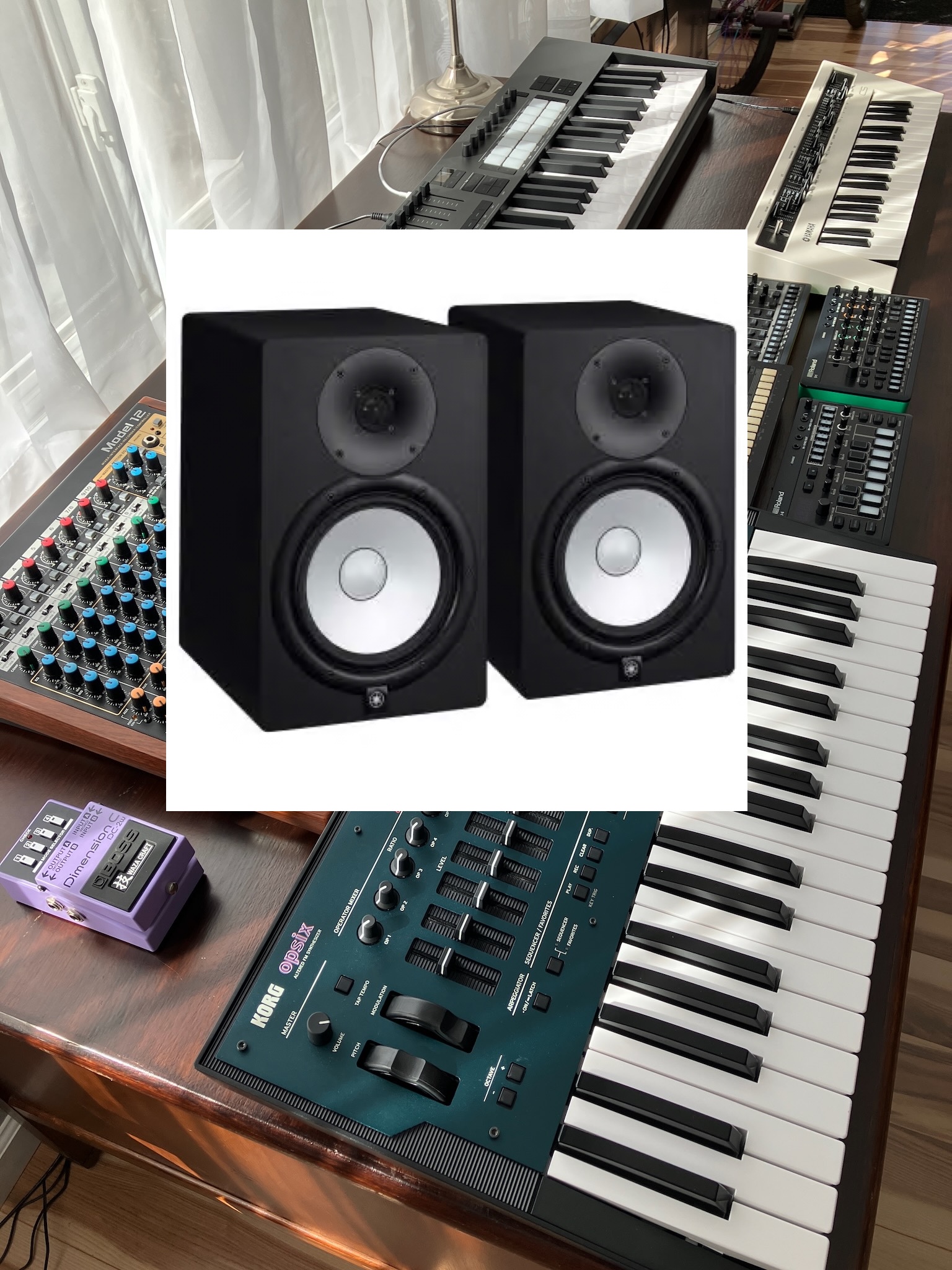
Of course, to really take advantage of that stereo separation I'd need something other than my mono Line-6 guitar amp to output the final mix. So, I'll be keeping an eye out for a good deal on a pair of powered studio monitors, like a set of Yamaha HS5 speakers, which look roughly like this:
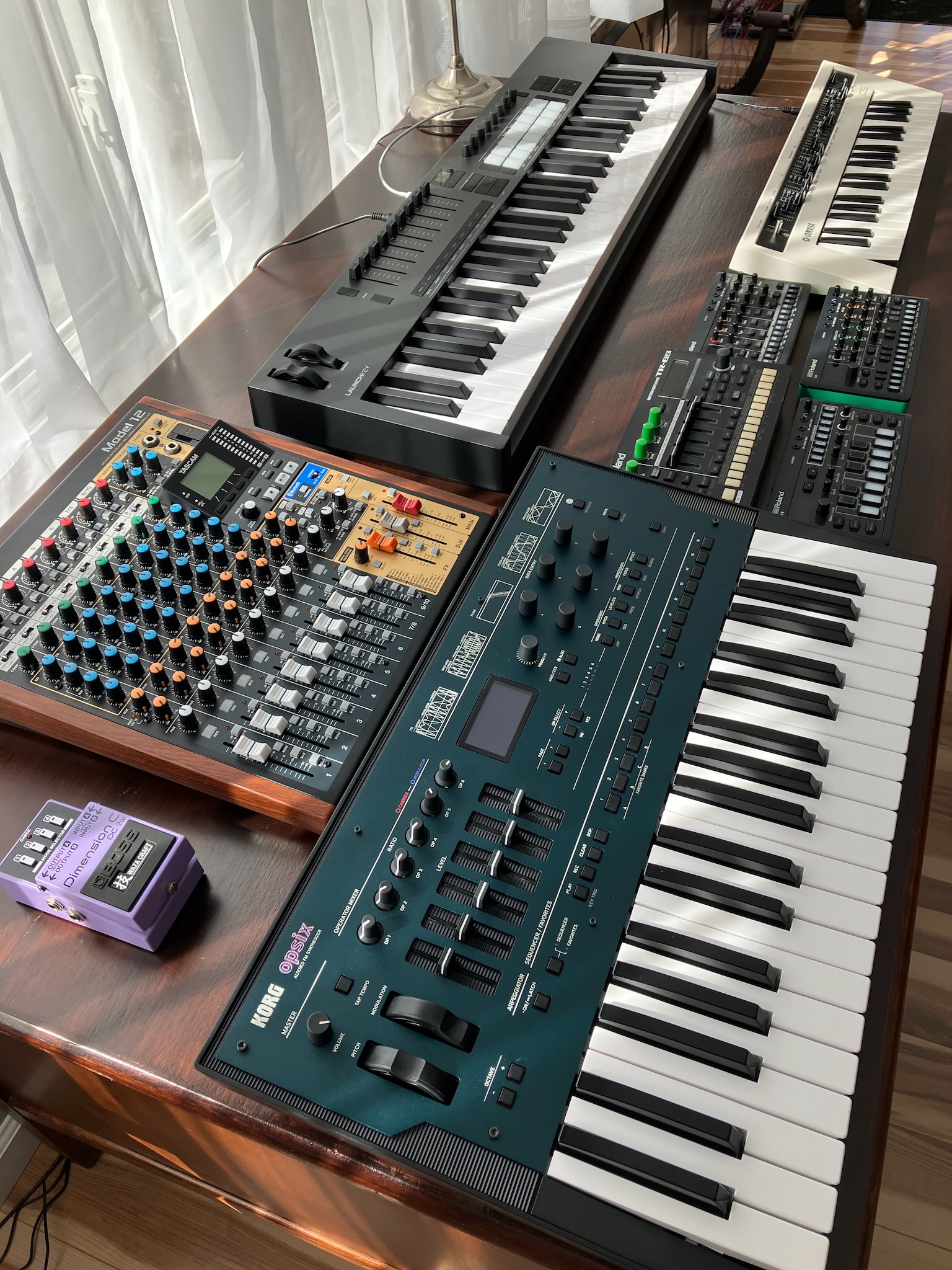
Hmm, damn. Well, I guess that wasn't going to keep working forever. Oh well, let's just have a good look at the setup so far.
Ah, so beautiful and clean... and also nothing's actually connected to anything else, so sadly we must summon the rat nest.
Well, that's not nearly as pretty but at least I can hear what I'm playing, which I suppose is the important part.
A little while ago, as you might remember, I picked up a MIDI keyboard so that I could goof around with making music. At least, music in key-form. This worked out pretty well, but I found that there was some friction with plugging the keyboard into my computer, booting up some synth software, setting up the instruments, etc...
So the other day while I was drifting through eBay, I happened upon a listing for a Yamaha Reface CS for a suspiciously low price. Of course the unit was marked as "Parts or Repair Only" which is music to my ears, and scanning the description showed that the speakers were apparently blown but the rest of the keyboard worked as expected.
Well, not having working speakers wouldn't really do well for me, as having to hook up the keyboard to an external amp wouldn't be much different than having to hook up my MIDI keyboard to my computer. But then, just as I was closing the tab, my finger slipped and...
Oh fiddlesticks, I guess I'll just have to fix it.
Now on the bright side, a new set of speakers for one of these Reface models is only about $35 and still in production, but before I fired up an order I figured I should at least do some due diligence to see if I could reproduce the problem.
Now you might have noticed something in the photo: there's a little 1/4 to 3.5 adapter plugged into the keyboard. I'll admit I thought the same thing you probably did: they probably forgot that this adapter was in the headphone jack, and having the adapter there would mute the speakers.
But alas no, it was in the line out port.
And removing it had no effect. Oh well, free 1/4" adapter I guess.
Well, let's put that adapter to use at least and see if the keyboard is functioning with it.
And indeed it is, so that's good.
So a new set of speakers it is... except there's something not quite right, still. This keyboard has stereo speakers, and neither of them is making any sound at all. Not a very quiet whimper; not some scratchy, distorted noise; not a single peep. That's peculiar. Very peculiar indeed.
Hmm, I wonder...
You know, just to be on the safe side, since who knows what configuration parameters the previous owner might have changed (inadvertently or otherwise), let's do a quick factory reset.
And wouldn't you know it, the speakers work just fine once you actually turn them on. There's nothing wrong with this keyboard at all.
Well, nothing critically wrong, that is.
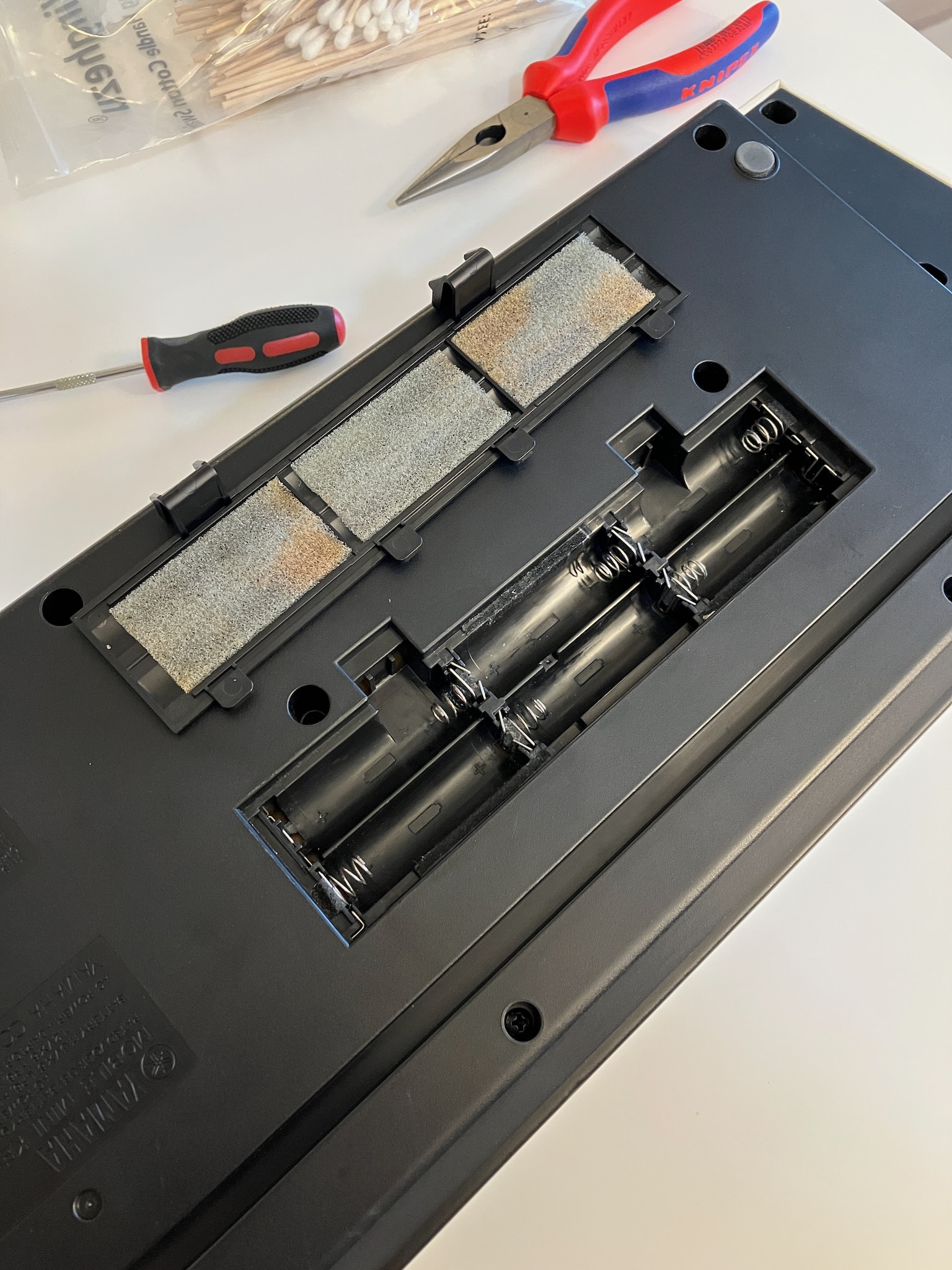
As is the case with anything that has a battery compartment, at some point someone will inevitably leave some batteries in it. This keyboard is no exception, and the previous owner had somehow even left 5 (not 6???) alkalines in the unit. There were also signs of leakage, though curiously not from this set of batteries.
In particular, this pair of terminals was a little crunchy, though luckily they weren't too damaged.
And the foam on the lid had soaked up quite a bit of electrolyte.
So it's plain white vinegar to the rescue to neutralize the caustic goo.
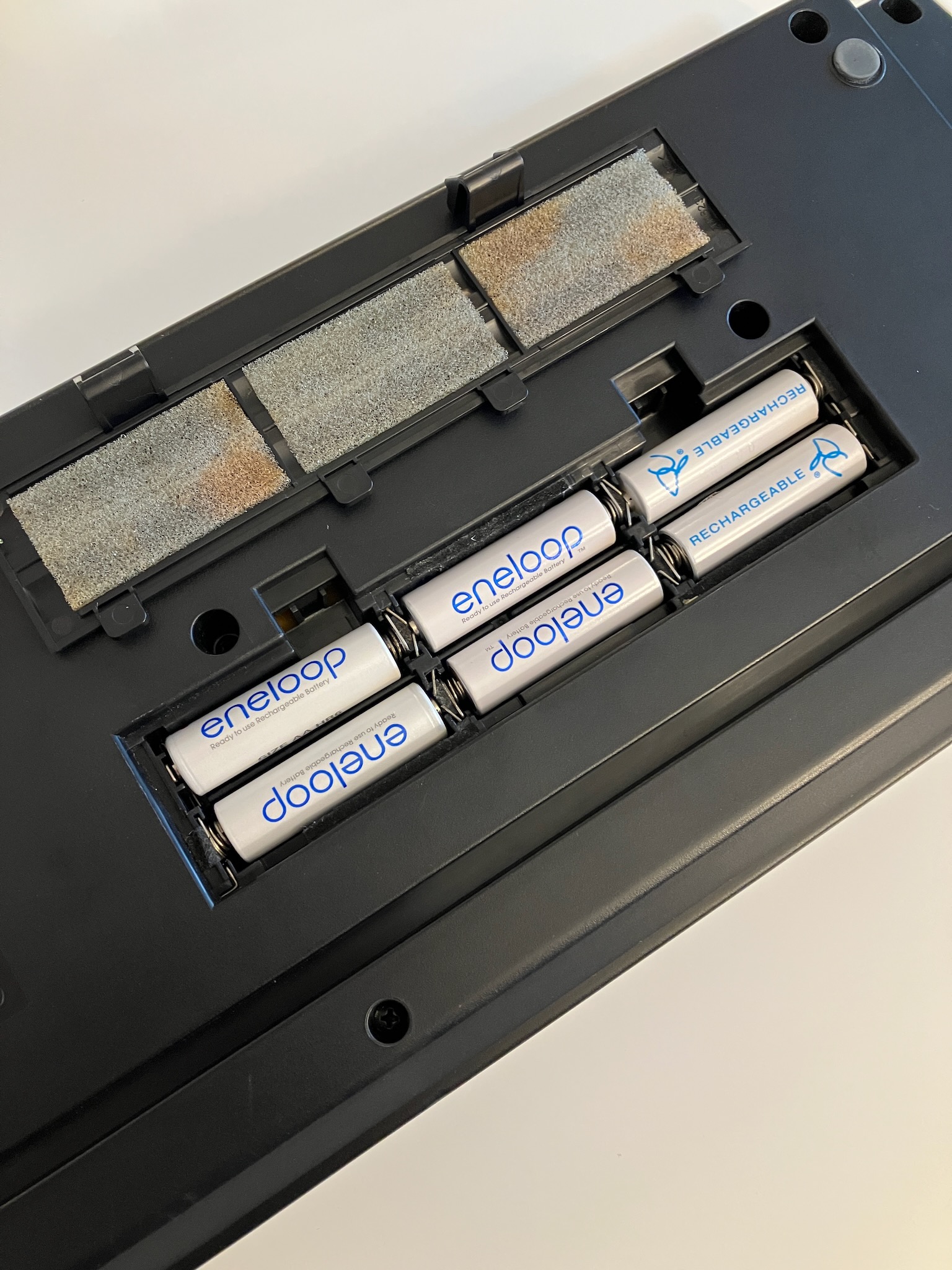
And while there's still a bit of rust staining left on the foam pads, things are basically clean again.
So, let's pop some batteries in there. Some nice NiMH cells that won't leak and destroy everything.
But that's peculiar, when I switch the unit on it acts like the batteries are almost completely dead, even though I just charged these.
Though, this one cell does look a bit lower than the others.
Ignore the negative voltage, the leads are reversed.
And with the unit powered on...
Ah, yes, it definitely shouldn't be reading -1 volts across this cell. For comparison, we'll pop one of the alkalines in its place.
And with the power on, and the leads the right way around this time...
Ok, that's much better, and the keyboard is functioning perfectly on battery power now too. I guess I'll order up some new NiMH cells, these ones are probably 15 years old at this point.
Well, just one final step left to go: update the firmware. That means plugging it in via USB.
Damn, it's a good thing I don't throw out old cables.
And install the update.
Then with just a little bit of cleaning to wipe off the leftover finger-schmoo from the previous owner...
It's looking as good as new.
And the only thing left to do is to make some noise with my extra-loud fidget toy.