Showing posts with label Boss DC-2w. Show all posts

Saturday, May 9, 2026

Squishing Sound

Continuing along on my effects journey, I wanted to round out my guitar signal chain with a compressor, and I picked the Boss CP-1X to do the job.

A compressor at its most core level will track the envelope of a signal, its overall volume, and when it exceeds a certain level it will turn down the gain on the signal. This compresses the dynamic range into a smaller dB window, which intuitively seems like it should make it sound like the louder parts get toned down a little.

However, what really happens is that the louder parts no longer dominate the quieter sections, and so in effect the compressor pedal lifts those quieter parts up in (relative) volume. This makes it sound like sustained notes ring out much longer, which can be very helpful if you want something that sounds more smooth and less plucky (which I often do).

But of course it doesn't just make the note tails longer, because as soon as another note gets played the envelope follower triggers the compression circuit to drop the gain again, and so new notes can essentially mute old notes, making sure that the sound doesn't get muddied up with too much happening at once.

This kind of effect works really well at the start of the signal chain, and for right now I'm thinking that this will be a good setup.

The compressor sits at the start of the chain to shape the signal coming straight out of the guitar. This particular compressor also includes an expander function where at very low volumes the compression is reversed and the gain is reduced. This ensures that background noise doesn't get amplified up into annoyingly audible levels when nothing else is playing, which can be an issue with less sophisticated compression effects.

This then gets fed into the Boss OC-5 Octave pedal which I discussed recently. I can bring this in and out depending on whether I want to play some bass lines or just guitar stuff.

Next we have the start of the tone shaping effects with the Boss DC-2w Dimension C chorus pedal. This adds a lot of depth, space and motion to the sound. It can also add stereo width, but I'll likely be running it in mono into the final pedal on the board.

The Zoom MS-50G takes up the final spot, where it will be providing a Reverb <- Amp Sim <- Delay chain. The delay effect gives a sharp echo to the sound, which can help consecutive notes harmonize together. The amp sim effect basically colours the sound in the same way that a number of classic guitar and/or bass amps would. Finally the reverb adds a diffuse echo to open up the soundstage and give the impression that the guitar was recorded in a physical acoustic environment rather than sounding like the raw audio is being poured directly into your ears.

So that's the guitar side of things taken care of, but what about squishing the rest of my sound? Well, it just so happens that I came across a Boss RCL-10 from their Micro Rack series.

This one is set up a little differently from the CP-1X. Rather than having a compressor and expander that work simultaneously, it instead has an overall control that allows you to dial in compression if you turn it in one direction, or expansion if you turn it in the other. It then has a separate noise gate which sharply cuts off the input when the volume drops below a certain level.

In practice one can set up the RCL-10 to act very similarly to the CP-1X by dialling in the main circuit for the desired level of compression and then tuning the noise gate to cut off just before any background noise is picked up.

But that's not the only thing you can do with it. Since the noise gate is separately configurable, you can also do silly tricks like feeding a reverb into it.

This causes the compressor to drag out the reverb trail until it reaches the noise gate threshold, at which point it gets sharply cut off. This was very characteristic of a lot of 80s drum sounds, and once you hear it you'll realize you recognize it in a lot of songs of the era.

Now, did I buy this compressor for that purpose? No. Well, maybe a little bit. I actually bought it because it was a really cheap Micro Rack effect in good condition, and in particular it still had the button caps on the power, effect and, around back, the input gain selector switch.

And I wanted a good example to be able to model and 3d print some replacements for my reverb unit.

Which is, you know, another future project to add to the pile.

Sunday, March 23, 2025

Robot Rock

Since we last left off, I discovered that the side of my room that I set up my music desk on gets kind of dark in the evening. Sadly, when this addition was built on the house, they didn't actually bother putting in any overhead lights and instead tried to make do with just a tiny bit of track lighting installed where a porch light once was.

But, it just so happened that I had a spare desk lamp kicking around, so I repurposed it here.

And speaking of additions to the desk, I'd been keeping an eye out for a good deal on a Roland Aira J-6. It's from the same line as the T-8 and S-1 pictured here, but while the T-8 is focused on drum and bass sequencing and the S-1 is focused on synth lead sequencing, the J-6 is instead built around sequencing chord accompaniments and arpeggiations.

Now I don't want to get too deep into music theory here, but my expectations for how the chord banks would be laid out, and how they are actually arranged, apparently did not align particularly well.

I don't feel like my expectations were too extravagant. I just assumed that within a given set of 12 chords I'd find that they were cohesively selected to align with a particular scale key and mode, with perhaps some creative selections where they borrow the occasional chord from related keys and modes.

And I certainly at least expected that they would be roughly arranged so that they generally rose in pitch as you ascended the keyboard.

Buuuuuuuut nope. From what I can tell there's really no theme at all to each bank of chords, and whether any pair of them makes sense tonally when played next to each other seems to be pretty much down to just luck. In fact, Roland seems to have put so little effort into the selection that they even accidentally duplicated at least one bank of chords. (For those curious, Bank 5, which they classified as "Jazz", contains a chromatic set of Major-9 chords, despite one being mislabeled as a Major-7 chord, and this is identical to Bank 21, which they classified as "Utility", which also contains the exact same chromatic set of Major-9 chords, note-for-note.)

So as a result you can either poke around the chord sets randomly (and the box gives you no visual indication of what chord it's actually playing when you hit each key) in hopes of lucking upon some combination that sounds good, or use the manual to try to reverse-engineer your way through the mess of chord banks.

However, the good news is that you can also just largely ignore the preset chord bank and just input your own chords into the sequencer by picking the notes on the built in 13-button keyboard. Somewhat annoyingly, you can't program the sequencer in step mode using an external midi keyboard. Curiously you CAN program the sequencer using an external midi keyboard when in live mode (where you play each step into the device in realtime) which is at least something I guess.

Honestly the J-6 feels like a bit of a half-baked product compared to the T-8 and S-1, though I expect I'll still get enough use out of it to justify the price (which wasn't much). If nothing else, it's a pretty neat 4-voice Juno emulator.

So, I think this lineup should keep me entertained for some time. I'll certainly be keeping an eye out for some good deals on a few other pieces of gear that I wouldn't mind adding to the setup. An upgraded drum machine might be nice, one that would get around the 32-step limitation of the T-8's sequencer, and perhaps give me more options for different drum sounds. The Roland TR-6s would fit the bill, and just to give you an idea of what it looks like, here's a photo of one:

Oh, whoops. Well, I guess it wasn't quite as hard as I thought to find one. Of course, this one was discounted for a reason, and it was a little bit rough when it showed up,

It had definitely seen a bit of cigarette smoke, plus it had been the victim of a few curious "customizations" by a previous owner, including swapping in the green knobs (which is fine, I guess), misplacing one of the fader knobs and substituting a mismatched one (I've got a matching one on the way), and adding some sort of green trim around the edge of the front panel, most of which had since chipped off.

And it was also filthy.

Luckily it's just a simple matter of popping the front cover off to disassemble and clean things.

Or at least it would have been simple if they hadn't, for some unknown reason, used an excessive amount of super glue to stick on that green trim.

But thankfully I was able to coax the top off after a great deal of struggling, without damaging any of the plastics. At least not any more than they already were.

The result after cleaning looks much nicer, though perhaps not quite perfect.

But sounding good is more important than looking good, and this drum machine sounds plenty good enough to be added to the bench.

So as I was saying, I'm not really in any hurry to add any more pieces to this setup, though I am keeping an eye open for any particularly good deals. For example, I wouldn't mind picking up a Korg Opsix synthesizer, which is an FM-based synth that has a lot of flexibility to produce tones that my Yamaha Reface CS can't do. Just to give you an idea of what one looks like, here's a photo:

Oh, whoops. I did it again, didn't I? Well, at least this one was in really good shape and didn't need any TLC to rehabilitate it.

But this does bring up a bit of an issue, in that I've got enough equipment on the bench that switching the audio back and forth is becoming a bit tedious. While the little Aira boxes have an audio pass-thru, as does my Yamaha Reface CS, neither the Opsix nor the TR-6S have that feature, meaning that I can't just chain everything into one long line to feed into the aux input on my little baby Line 6 guitar amp.

It's not really the end of the world, though, so I'm just planning to keep my eye open for a good deal on a mixer, maybe one with a built-in multi-track recorder. Something like the Tascam Model 12 would do the trick, and just to give you an idea of what one looks like, here's a photo:

Hmm, I really need to stop finding such good deals. In this case, the deal was extra sweet because the unit was malfunctioning. There's a bit of a well-known achilles heel on this model, which is that Tascam specced a really shitty power switch, and as a result the box will refuse to turn on once that $1 part suffers its inevitable premature death.

Thankfully the fix is very easy to perform for anyone who's even slightly adventurous, as I've documented here:

Ok, phew, that should be it for now. Anything else from this point on wouldn't fit on my desk, and really the only thing I could think to add might be something like a chorus effect pedal. The chorus effect really adds a lot of space and depth to synthesizer sounds, but it's not always included as a built-in feature on every synthesizer. Notably, the J-6 box doesn't include it, despite the original Juno synth that it's based on having one of the most widely celebrated chorus effects. So I'll be keeping an eye out for a deal on something like a Boss Dimension C DC-2w, which would probably fit the bill, and it even comes in a lovely purple colour as you can see here:

Well shoot, how does this keep happening?

Anyway, this chorus effect pedal takes a relatively flat sounding mono (or stereo, as of the Waza Craft edition which I have here) signal and applies a sort of phase-modulated delay to it that really livens up the sound, and in particular it gives it a ton of stereo separation.

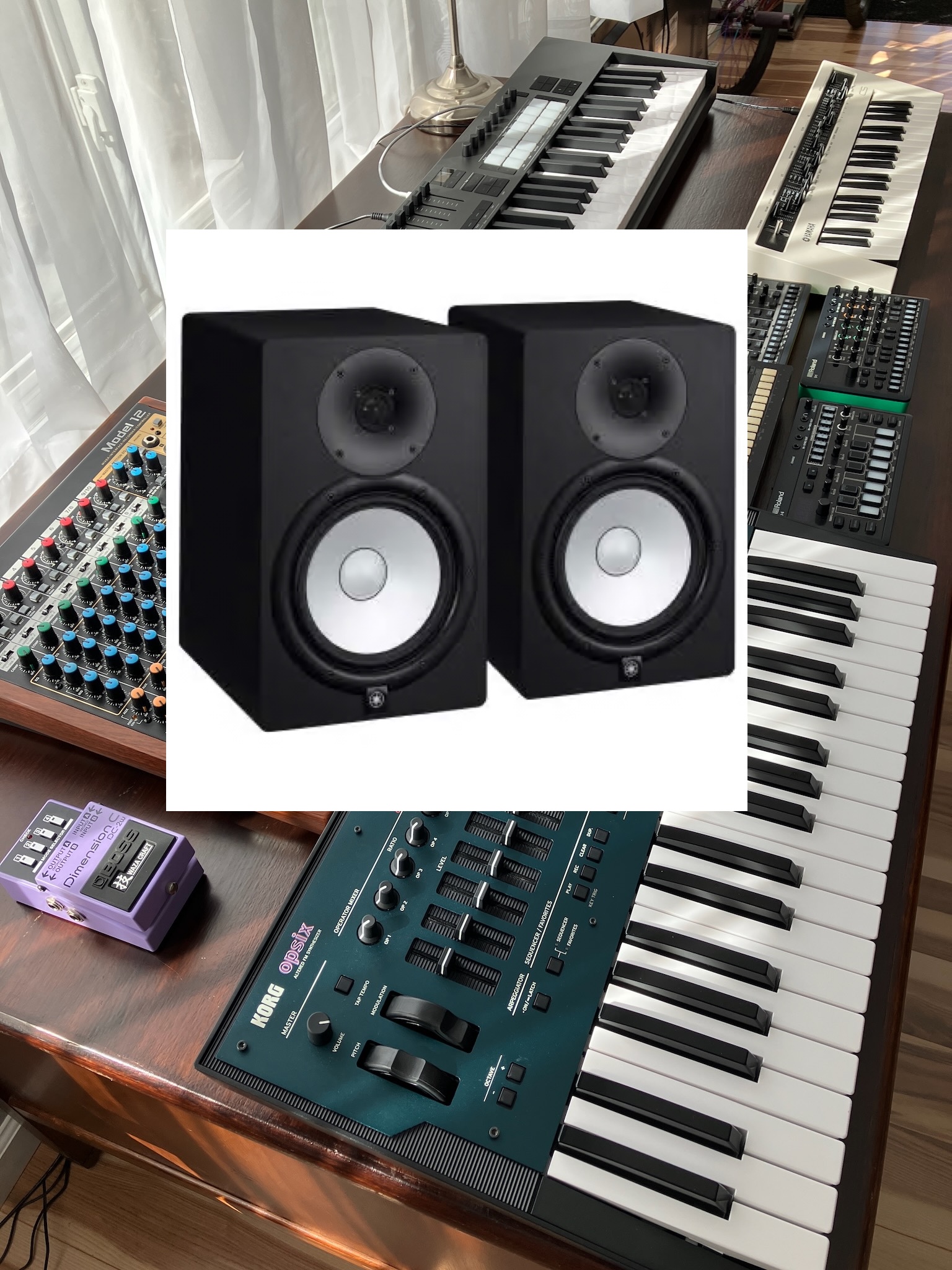
Of course, to really take advantage of that stereo separation I'd need something other than my mono Line-6 guitar amp to output the final mix. So, I'll be keeping an eye out for a good deal on a pair of powered studio monitors, like a set of Yamaha HS5 speakers, which look roughly like this:

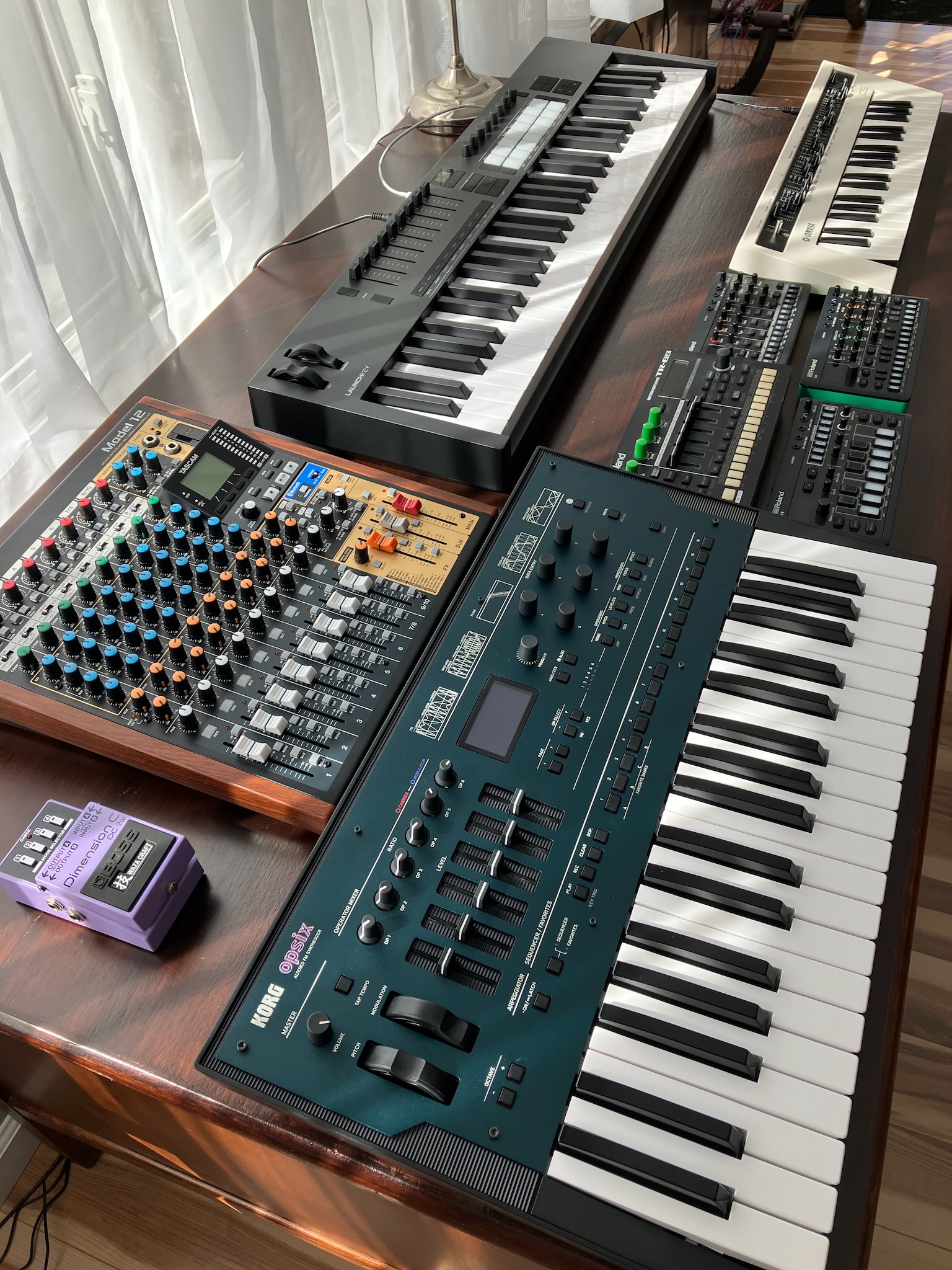
Hmm, damn. Well, I guess that wasn't going to keep working forever. Oh well, let's just have a good look at the setup so far.

Ah, so beautiful and clean... and also nothing's actually connected to anything else, so sadly we must summon the rat nest.

Well, that's not nearly as pretty but at least I can hear what I'm playing, which I suppose is the important part.